Blog

  • My Father Died in a Hospital… Then the Lawyer Revealed His $48 Million Secret

    The hospital hallway smelled like antiseptic and quiet despair.

    Machines beeped softly behind closed doors, and the fluorescent lights flickered above me as if they were tired too.

    I had been sitting in that plastic chair for eleven hours.

    My father was dying.

    The doctors said there was nothing more they could do.
    Stage four pancreatic cancer.
    Too late. Too aggressive.

    My name is Daniel Carter. I’m 34. And until that night, I thought my father was just a quiet mechanic who lived a simple life.

    I was wrong.

    A nurse finally stepped out of the ICU.

    “Mr. Carter… the doctor will see you now.”

    My legs felt like concrete as I followed her inside.

    My father looked smaller than I remembered. The oxygen mask covered half his face, and the machines around him breathed louder than he did.

    When he saw me, he tried to smile.

    “Danny… you came.”

    I grabbed his hand.

    “Of course I did.”

    He squeezed weakly and whispered something that made no sense.

    “Did the lawyer arrive yet?”

    I frowned.

    “Lawyer?”

    He nodded slowly.

    Just then, the door opened.

    A tall man in a grey suit walked in holding a leather briefcase.

    “Mr. Carter,” he said calmly.
    “My name is Jonathan Reeves. Your father asked me to come tonight.”

    I looked at my father, confused.

    The lawyer placed a folder on the small hospital table.

    “Your father has something important to tell you.”

    My father removed the oxygen mask for a moment and whispered:

    “Danny… I never told you who I really was.”

    My heart started pounding.

    “What do you mean?”

    The lawyer opened the folder and slid a document toward me.

    My hands started shaking when I saw the number printed at the top.

    $48,000,000

    I looked up in shock.

    My father closed his eyes and whispered:

    “Son… I’m not a mechanic.”

    And before I could ask anything else…

    The heart monitor beside him suddenly screamed.

    BEEEEEEEEEP.

    The flatline echoed through the hospital room.

    Doctors rushed in.

    Nurses pushed me back toward the door.

    But I couldn’t move.

    My father was gone.

    Just like that.

    Minutes later, I sat in the empty hospital waiting room with the lawyer across from me.

    The folder was still on the table between us.

    I stared at the number again.

    “Forty-eight million dollars…”

    “This must be some mistake.”

    The lawyer shook his head calmly.

    “No mistake.”

    He opened another document.

    “Your father, Michael Carter, owned six automotive patents used by major car manufacturers.”

    I blinked.

    “My father fixed rusty trucks in a garage.”

    The lawyer gave a small smile.

    “Yes… by choice.”

    He slid another photo toward me.

    It showed my father standing next to a luxury sports car I had never seen.

    “He sold the patents twenty years ago,” the lawyer explained.

    “For over fifty million dollars.”

    My chest tightened.

    “If he was rich… why did we grow up poor?”

    The lawyer looked at me carefully before answering.

    “Because your father believed money destroys families.”

    He paused.

    “He watched his own brothers fight over inheritance and never speak again.”

    I felt something break inside my chest.

    “So he lied to me my whole life?”

    The lawyer shook his head slowly.

    “No.”

    He pushed the final letter toward me.

    “Read the last page.”

    My hands trembled as I unfolded it.

    It was written in my father’s handwriting.

    Danny,
    If you’re reading this, I’m already gone.

    I didn’t hide the money because I didn’t trust you.

    I hid it because I wanted you to grow up rich in the only way that matters.

    Kindness.

    Hard work.

    And humility.

    At the bottom of the page was one final sentence that made my eyes fill with tears.

    The money is yours now…

    But the man you became without it…

    That was the real inheritance.
  • “The Beggar Outside My Office Asked for One Dollar — I Gave Him Something Else Instead.”

    Every morning at exactly 7:45, he sat outside my office building.

    Same spot.
    Same worn coat.
    Same cardboard sign.

    “Just trying to eat today.”

    For months, I walked past him without stopping.

    Not because I didn’t care.

    Because I told myself the same lie everyone else does:
    “Someone else will help him.”

    One morning, it was freezing. The kind of cold that makes your hands hurt even in your pockets.

    He looked worse than usual.

    His hands were shaking.

    As I walked by, he quietly said:

    “Sir… do you maybe have one dollar?”

    Just one dollar.

    I stopped.

    Not because of the dollar.

    Because when he looked up at me… I saw something in his eyes.

    Not desperation.

    Dignity.

    I reached into my wallet.

    But instead of giving him a dollar…

    I said something that surprised even myself.

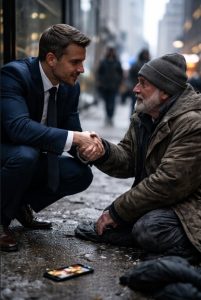
    “Stand up,” I told him.
    “I’m taking you somewhere warm.”

    People walking by stared.

    A rich man in a suit helping a beggar off the sidewalk.

    But what happened next… changed both of our lives forever.

    👇 Continue reading in the comments… because what I discovered about that “beggar” inside the café shocked everyone around us.

    Inside the café, he sat quietly, like he didn’t belong there.

    I ordered him breakfast.

    Eggs. Coffee. Toast.

    He stared at the food like he hadn’t seen a meal in days.

    Before eating, he said something I didn’t expect:

    “Thank you… but I used to be like you.”

    I laughed softly.

    “Like me?”

    He nodded.

    “Ten years ago, I owned a construction company.”

    Then he told me the story.

    A bad business partner.
    A lawsuit.
    A divorce.
    Debt.

    Everything collapsed.

    Friends disappeared.

    Family stopped answering calls.

    And slowly… he ended up on the street.

    But then he said something that stayed with me forever:

    “You’re the first person in months who looked at me like I was still human.”

    That sentence hit harder than anything.

    Because the truth is…

    Most people don’t lose their lives overnight.

    They lose them one ignored moment at a time.

    I helped him contact an old friend that day.

    Three months later…

    He wasn’t sitting outside my office anymore.

    One morning I saw him again.

    But this time…

    He was wearing a clean jacket.

    Standing tall.

    And smiling.

    Sometimes the biggest change in someone’s life doesn’t start with money.

    It starts with someone finally stopping long enough to see them.

  • They Went to Italy While I Buried My Son — And Then My Phone Vibrated.

    My parents stayed exactly fifteen minutes.

    I watched them check their Rolex watches before rushing off to catch their flight.

    “This is terrible timing,” they said.
    “We can’t cancel the trip. We’ll grieve when we get back.”

    I laid my son to rest on a cold, gray Friday morning.

    The front-row seats reserved for his grandparents stayed painfully empty.

    As the tiny white casket was lowered into the earth, my phone vibrated.

    Through tear-blurred eyes, I read the message.

    From my mother.

    “Thinking of you. The rehearsal dinner just started. The sunset here is breathtaking. Wish you were here.”

    There was a photo attached.

    My parents, glowing under golden light, champagne glasses raised, rolling Italian hills behind them.

    I stared at their smiling faces.

    And something inside me shifted.

    The tears dried.

    The grief hardened into something colder. Sharper.

    They celebrated beneath a perfect sky, unaware that with that single photo, they had closed a door between us forever.

    Did they think that was the end?

    It wasn’t.

    👇 Continue reading in the comments… because what happened next changed everything, and they would never see it coming.

    I didn’t reply. I didn’t text back.

    Instead, I watched, waited, and let the silence grow.

    In the following weeks, life unfolded differently than they imagined.

    • Family secrets surfaced.

    • Friends whispered things they’d never dared to say.

    • And I discovered truths about my parents I hadn’t known — about privilege, indifference, and the walls they built around themselves.

    Every photo, every message, every missed call became a reminder:
    They weren’t just absent at my son’s funeral.
    They were absent in the ways that truly mattered.

    And yet… that absence revealed something unexpected.

    I realized that grief doesn’t just break us.
    It can also sharpen our vision, clarify who we are, and expose the truths others try to hide.

    By the time they returned from Italy, I wasn’t the same person they had left behind.

    And neither would they be.

  • I Heard My Neighbor Crying at Midnight — What I Found Changed My Life Forever.

    It was 12:03 AM when I heard it.

    A soft, desperate cry coming from the apartment next door.

    I live in a quiet building. I know my neighbors. None of them ever cry at night.

    I grabbed my keys and stepped outside, my heart pounding.

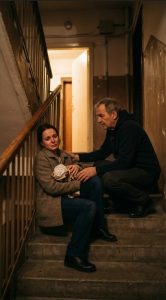
    I saw her — a woman in her late 30s — sitting on the steps, shaking, holding a tiny bundle wrapped in a blanket.

    She looked up at me with wide, terrified eyes.
    “Please… can you help?” she whispered.

    I froze.

    I didn’t know what was happening.

    Was it her baby? Her husband? Her life falling apart?

    She held out the bundle.

    It was a tiny, newborn baby. Her own child. Alone. The mother couldn’t care for it — or maybe had nowhere to go.

    I called 911 immediately, but something stopped me from walking away.

    I sat down beside her.

    We didn’t speak for a few minutes. Only the sound of her trembling.

    Then she whispered something that broke my heart:

    “I… I can’t do this alone.”

    I looked down at the baby. Tiny, fragile, perfect.

    I had never held a newborn in my life.

    And yet, in that moment, I knew:

    I had to help.

    Because sometimes, life chooses you — whether you’re ready or not.

    👇 Continue reading in the comments… because what happened after we brought that baby inside revealed a secret that no one expected.

    The baby was quiet now, almost as if it knew it was safe for the first time.

    We called social services, but the woman refused to leave. She needed someone to stay with her, she said. She didn’t trust anyone else.

    Over the next few hours, I learned her story:

    • She had fled an abusive household.

    • She had nowhere to go.

    • She feared the baby would be taken from her forever.

    I stayed by her side.

    We wrapped blankets, fed the baby, and I held it in my arms — the smallest, most perfect thing I had ever touched.

    I realized something:

    In the middle of despair, human connection can save lives.
    A stranger can become family in one night.

    By sunrise, the mother was calm. She smiled for the first time since midnight. She whispered:

    “Thank you… for not walking away.”

    And I understood something I’ll never forget:

    Life’s most powerful moments aren’t announced.
    They arrive at midnight.
    They arrive in fear, tears, and desperate cries.
    They arrive when you choose to act instead of look away.

    Because sometimes, being a hero doesn’t mean saving the world.
    It means saving one life.

  • At 3:42 AM I Got a Missile Alert Because the US and Israel Had Bombed Iran — Then My Daughter Said Something That Broke Me.

    The phone buzzed at 3:42 AM:

    “Civil defense alert: Incoming missile threat. Take shelter now.”

    My heart didn’t race.

    It fell.

    Not because I didn’t understand the war.

    I understood it perfectly:

    • The U.S. and Israel launched heavy strikes against Iran’s strategic sites — top leaders and infrastructure, triggering unprecedented retaliation.

    • Iranian missiles and drones have struck U.S. bases and allied nations across the Middle East.

    • Governments are issuing evacuation advisories for civilians across the region.

    But this alert wasn’t over there.

    It was here.

    Right in my pocket.

    I heard sirens in the distance — somewhere off in the city.

    My partner sat up in bed, eyes wide.

    “What was that?”

    Before I could answer…

    My daughter walked into the room.

    Barefoot. Hair messy.

    And she said something I wasn’t ready to hear:

    “Is this the war I saw on TV?”

    I froze.

    Her voice was calm. Too calm.

    Almost accepting.

    Then my partner held my hand tight.

    And that’s when the second alert came through:

    “Secondary alert: Missile impacts possible within 10 min.”

    I didn’t know whether to panic…

    or gather everyone and run.

    Because in that moment, war was no longer a news headline — it was in our home.

    👇 Continue reading because what my daughter said next made me realize something profound about fear and hope that changed how I see this conflict.

    We huddled in the basement with only the glow of our old flashlight.

    My daughter — just nine years old — looked up and asked:

    “Do you think people are dying right now?”

    I didn’t have an answer.

    Because yes, they were.

    War isn’t fiction.

    • Reports say hundreds have died in Iran and across the region, including civilians, as U.S. and Israeli strikes continue.

    • Iran is retaliating with missiles at Israel, U.S. forces, and other Gulf states.

    • Global leaders are warning the conflict could continue with no clear end date.

    But what I told her wasn’t about bombs.

    I knelt beside her.

    “I don’t know the answer to that,” I said softly.

    “But if people are hurting… then it’s important we stay kind.”

    She stared at me with wide eyes.

    Not because she didn’t understand fear…

    But because she understood responsibility.

    Then she said something I’ll never forget:

    “War won’t end until people stop being afraid of peace.”

    That broke me.

    Not missiles.

    Not alerts.

    Not fear itself.

    But the idea that children are growing up thinking war is normal.

    Because when your child asks about peace instead of safety…

    You realize something incredible:

    The world may be dangerous,
    but hope is still being born in young hearts.

    And maybe — just maybe — that matters more than weapons, missiles, or any declaration of war.

  • My Wife Texted Me “Don’t Come Home.” I Thought She Was Angry.

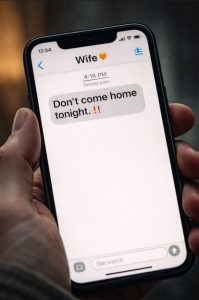
    My wife texted me at 4:16 PM:

    “Don’t come home tonight.”

    No explanation.
    No emojis.
    Nothing.

    I called her immediately.

    No answer.

    Called again.

    Voicemail.

    We weren’t fighting.
    We weren’t distant.
    At least… I didn’t think we were.

    My first thought?

    She found out.

    About the late nights.
    The extra hours.
    The lies about “traffic.”

    But it wasn’t another woman.

    It was worse.

    When I finally got through to her, her voice didn’t sound angry.

    It sounded… empty.

    “Just stay at your brother’s tonight,” she said.

    “Why?” I asked.

    Silence.

    Then she said something that made my stomach drop.

    “I can’t let him see you like this.”

    Him?

    Our son?

    “See me like what?”

    She hung up.

    I drove home anyway.

    Of course I did.

    When I pulled into the driveway, the house was dark.

    But the living room light flicked on.

    And there he was.

    My 10-year-old son.

    Standing at the window.

    Watching me.

    Not smiling.

    Not excited.

    Just… studying me.

    When I walked inside, he didn’t run to hug me like he usually does.

    He stepped back.

    Like he wasn’t sure.

    And that’s when I smelled it.

    On myself.

    Whiskey.

    I had stopped at the bar after work.

    Like I always do.

    “One drink” had turned into four.

    Like it always does.

    I looked at my wife.

    Her eyes weren’t angry.

    They were exhausted.

    And then my son said something that I will hear for the rest of my life.

    👇 Continue reading in the comments… because what my son asked me next exposed a truth I had been hiding from myself for years.

    He looked up at me and asked:

    “Are you sick, Dad?”

    Not drunk.

    Not angry.

    Sick.

    Like he thought I needed help.

    Like he had been worried about me.

    My wife whispered quietly:

    “He asked me that last week too.”

    Last week.

    How long had this been happening without me realizing it?

    How many nights did I walk through that door thinking everything was normal?

    Thinking I was still the same father?

    I always told myself I wasn’t an alcoholic.

    I never missed work.
    I paid the bills.
    I showed up to games.

    But children don’t measure love in responsibilities.

    They notice presence.

    And absence.

    That night I didn’t argue.

    I didn’t defend myself.

    I didn’t say, “It’s not that bad.”

    Instead, I knelt down in front of him.

    And for the first time in years, I told the truth.

    “I think I might be.”

    My son put his small hand on my arm.

    And said something I’ll never forget.

    “Then we can fix it, Dad.”

    Not you.

    We.

    Sometimes the moment that saves you…

    is when your child thinks you are the one who needs saving.

  • My Daughter Said Goodbye to Me This Morning. I Thought She Meant for School.

    “Goodbye, Daddy.”

    Not “see you later.”
    Not “pick me up at three.”

    Goodbye.

    She hugged me tighter than usual.

    Seven years old.

    Small hands.

    Long pause.

    I laughed.

    “Hey, you’ll be back in a few hours.”

    She just nodded.

    On the way to work, I got a call from her school.

    Car accident.

    A woman had tried to beat a red light.

    Hit a group of children crossing with the teacher.

    I don’t remember driving there.

    I don’t remember parking.

    I only remember the sound.

    Parents screaming names.

    Ambulance doors slamming.

    A small pink backpack on the ground.

    Hers.

    Someone told me she was conscious.

    Someone told me she asked for me.

    At the hospital, a nurse stopped me.

    “She keeps saying she’s sorry.”

    Sorry?

    For what?

    When I finally saw her, she looked so small in that big hospital bed.

    Bruised.

    Oxygen tube.

    Her tiny fingers wrapped around mine.

    “Daddy,” she whispered.
    “I didn’t want you to be mad.”

    Mad?

    “About what, baby?”

    Her voice cracked.

    “I didn’t tell you I felt sick this morning.”

    The room went silent.

    “I thought I was just scared for the math test.”

    She paused.

    “But when the car came… I couldn’t run fast.”

    My heart stopped.

    She knew.

    She knew something wasn’t right.

    And she didn’t tell me.

    Because she didn’t want to “make a big deal.”

    The doctor walked in then.

    And what he said next made my knees give out completely.

    👇 Continue reading because what they found wasn’t caused by the accident — and I almost missed the warning signs.

    “It’s not just the impact,” the doctor said.

    They had run scans.

    Precautionary.

    Standard procedure.

    But they found something else.

    A mass.

    Near her lung.

    Small.

    But there.

    The accident didn’t cause it.

    It exposed it.

    The dizziness she felt that morning?

    Not nerves.

    The tiredness the past few weeks?

    Not laziness.

    The quiet cough at night?

    Not “just allergies.”

    All the small signs.

    All the times she said, “I’m okay.”

    And I believed her.

    Because I was busy.

    Because I was tired.

    Because life was loud.

    And she was quiet.

    The doctor said we caught it early.

    Treatable.

    But if not for that accident?

    We might not have known for months.

    That night, sitting beside her hospital bed, she looked at me and whispered:

    “Are you mad at me?”

    Mad?

    I kissed her forehead.

    “No, baby,” I said.
    “I’m mad at myself for not listening better.”

    She smiled weakly.

    “Next time I feel weird, I’ll tell you.”

    And I realized something I’ll never forget:

    Sometimes children don’t hide pain because they’re brave.

    They hide it because they don’t want to be a burden.

    And that realization
    is heavier than anything.

  • The Day I Evicted My Own Mother

    I didn’t recognize her name on the eviction list.

    That’s what I told myself.

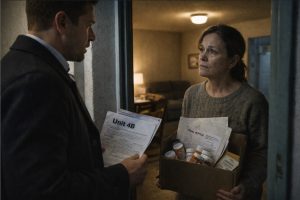
    Unit 4B.
    Three months unpaid rent.
    Final notice.

    I had signed hundreds of eviction papers in my career as a property manager.
    Names blur after a while.

    Until I knocked on the door.

    And my mother opened it.


    She looked smaller.

    Not older. Not weaker.

    Just… smaller.

    Like life had been quietly folding her in on herself.

    We hadn’t spoken in almost two years.

    The last time, we argued.

    She said I cared more about money than family.

    I told her family doesn’t pay the bills.

    Irony has a cruel sense of humor.


    “I didn’t know this was your building,” she said softly.

    Neither did I.

    Or maybe I just never checked.

    Because who expects their mother to be three months behind on rent?


    The apartment was cold.

    Half the lights were off.

    The fridge made that empty humming sound.

    On the kitchen table was a stack of unopened envelopes.

    Medical bills.

    That’s when I saw the pill bottles.

    That’s when I understood.


    “You should have told me,” I said.

    She smiled.

    “When did you last have time to listen?”

    That one landed harder than any accusation.


    I told her I would “see what I could do.”

    Professional voice.

    Neutral tone.

    The same voice I use with strangers.

    But she isn’t a stranger.

    She’s the woman who worked double shifts so I could study business.

    The woman who skipped meals so I wouldn’t.

    And now I was holding the paper that could put her on the street.


    I walked back to my office.

    Sat at my desk.

    Looked at the eviction form.

    All I had to do was sign.

    One signature.

    Policy is policy.

    Fair is fair.

    If I bend the rules for her, I bend them for everyone.

    That’s what I’ve always believed.


    My pen touched the paper.

    And then my phone rang.

    It was the bank.

    About my own mortgage.


    👉 Continue reading… because that phone call changed which one of us was about to lose a home.

    The bank representative didn’t sugarcoat it.

    “If the late payment isn’t received by Friday, foreclosure procedures will begin.”

    Foreclosure.

    On my house.

    The house I bought to prove I made it.

    The house my mother has never visited.

    Because I was “too busy.”


    I hung up and stared at the eviction form again.

    Three months behind.

    Medical bills.

    Pride too heavy to ask for help.

    Sound familiar?

    I always thought I built my success alone.

    But that’s not true.

    She built it.

    I just lived in it.


    I drove back to Unit 4B.

    She opened the door before I knocked.

    Mothers know.

    “I can’t cancel it,” I said.

    Her face didn’t change.

    “I know.”

    “But I can transfer you.”

    She looked confused.

    “To my guest room.”

    Silence.

    The kind that breaks people open.


    She tried to protest.

    Said she didn’t want to be a burden.

    I laughed for the first time in months.

    “You carried me for 18 years,” I said.
    “I can handle a spare bedroom.”


    We moved her things that weekend.

    Two suitcases.

    One box of old photo albums.

    That’s all she had left.


    Three weeks later, she was sitting at my kitchen table.

    Cooking.

    Criticizing my knife skills.

    Laughing.

    The house didn’t feel like a trophy anymore.

    It felt like a home.


    I didn’t lose my house.

    The bank worked out a plan.

    But even if I had?

    At least this time, I would have known what matters.


    Sometimes success makes you forget who paid the first bill.

    Sometimes pride costs more than rent.

    And sometimes…

    The person you’re about to evict

    Is the reason you ever had a door to knock on.

  • “My Son Stopped Asking”

    My name is Elena.

    I’m 34 years old. Single mom. One son.

    And three weeks ago, my son stopped asking for things.

    At first, I didn’t notice.

    Then I realized…
    he hadn’t mentioned the school trip in days.

    Every year, his class goes to the science museum.
    He had talked about it for months.

    But suddenly?

    Silence.

    One night, while folding laundry, I asked casually:

    “Aren’t you excited about the trip anymore?”

    He shrugged without looking at me.

    “It’s okay.”

    That was new.

    My son is never “okay.”


    The permission slip was still in his backpack.

    At the bottom, in red ink:

    $45 due Friday.

    Friday was tomorrow.

    My bank account had $12.03.

    I sat on the edge of my bed and stared at that number like it might change if I looked long enough.

    It didn’t.


    Later that night, I walked past his bedroom.

    The door was slightly open.

    He was at his desk, counting coins.

    Pennies. Nickels. Dimes.

    He had a little pile going.

    Then he stopped.

    And pushed them all back into a small dinosaur piggy bank.

    I heard him whisper to himself:

    “It’s fine. I don’t even like museums.”

    My chest physically hurt.


    The next morning, he didn’t give me the permission slip.

    He didn’t remind me.

    He didn’t ask.

    He just kissed my cheek and said:

    “Have a good day, Mom.”

    And that’s when I realized…

    He wasn’t being brave.

    He was protecting me.


    👉 Continue reading… because what I found under his pillow that night made me realize how long he had been pretending.

    That night, I went into his room after he fell asleep.

    I told myself I was just tucking him in.

    But really… I was looking for that permission slip.

    It wasn’t in his backpack anymore.

    It wasn’t on his desk.

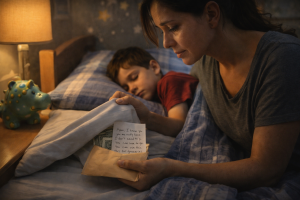
    Then I noticed something slightly sticking out from under his pillow.

    An envelope.

    My hands shook as I opened it.

    Inside were crumpled bills.

    $1.
    $5.
    Even a $10.

    Twenty-seven dollars total.

    And a note written in pencil.

    “Mom, I know you work really hard. I don’t need to go. You can use this for groceries. I’ll watch videos about it instead.”

    I sat on his floor and cried silently so I wouldn’t wake him.

    Because this wasn’t about a museum anymore.

    This was about a child who learned too early that money is heavy.


    The next morning, I went to the school.

    I asked to speak to the teacher privately.

    I explained. I apologized.

    I hated how small my voice sounded.

    The teacher looked at me for a long moment.

    Then she said softly:

    “Mrs. Alvarez… your son already paid.”

    My heart stopped.

    “What?”

    She smiled gently.

    “He gave me an envelope yesterday. He said it was all he had. I told him the rest was taken care of.”

    I felt the room tilt.

    “The rest?”

    She nodded.

    “The PTA has a quiet fund for moments like this. But he didn’t know that.”


    When I picked him up that afternoon, he ran to me.

    “Mom! Guess what? I’m going!”

    I knelt down and held his face in my hands.

    “You were always going,” I whispered.

    That night, I put the $27 back under his pillow.

    But I added something else.

    A small folded note.

    “You never have to protect me. That’s my job.”


    Some people think poverty is just numbers.

    It’s not.

    It’s the moment your child learns to shrink his dreams so yours don’t feel smaller.

    And I promised myself that night…

    He will never stop asking again.

  • “He Refused to Buy the Shoes”

    My name is Daniel Carter. I’m 41 years old.

    And last Saturday, my daughter looked at me like I had broken her heart.

    We were standing in a small shoe store.
    She was holding a pair of white sneakers against her chest.

    “They’re on sale, Dad.”

    They were $38.

    I checked my bank app while pretending to look at the price tag again.

    $14.72.

    I forced a smile.

    “Maybe next month.”

    She nodded too fast. Too brave.

    “It’s okay. Mine still fit.”

    They didn’t.

    I had seen the red marks on her heels that morning.


    That night, after she went to bed, I opened the kitchen drawer filled with unpaid bills.

    Electricity overdue.
    Car payment tomorrow.
    Insurance final notice.

    I stared at my old guitar leaning against the wall.

    It was the last thing I kept after her mom left.

    I listed it for sale.

    Within an hour, someone offered $60.

    I hesitated.

    Then I typed:
    “Deal.”


    The next afternoon I picked up the sneakers.

    I imagined her face when she’d open the box.

    But when I got home, something stopped me cold.

    A small glass jar on the kitchen table.

    Inside were crumpled bills and coins.

    And a folded note.

    “Dad, I’ve been saving from my lunch money. You can use this for bills. I don’t need the shoes.”

    Inside the jar…

    $39.16.

    More than the shoes cost.

    My hands started shaking.

    And then my phone buzzed.

    A message from the guitar buyer.

    “I Googled you. You used to play at charity events. Keep the guitar. I just sent extra.”

    I checked my account.

    $100.

    No name. No explanation.

    Just:

    “For her.”

    And that’s when I realized…

    this wasn’t just about shoes anymore.


    👉 Continue reading… because three days later, my daughter did something at school that would change not just our lives — but the lives of dozens of other families.

    Three days later, my phone rang at work.

    “Mr. Carter? This is the school principal. Could you come in today?”

    When you’re barely staying afloat, every unexpected call feels like disaster.

    My heart was already racing before I hung up.

    All I could think was:
    Please don’t let it be something I can’t fix.


    When I walked into the office, my daughter was sitting there.

    Wearing the new white sneakers.

    She ran toward me and hugged me tightly.

    I noticed something strange.

    She wasn’t in trouble.

    She looked… proud.

    The principal smiled.

    “Your daughter started something.”

    I frowned.
    “Started what?”

    He turned his computer screen toward me.

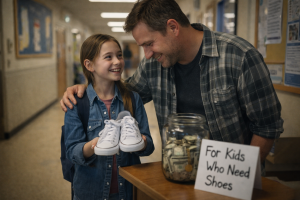
    There was a photo of a mason jar sitting on her classroom desk.

    With a handwritten label:

    ‘For Kids Who Need Shoes.’

    My chest tightened.

    “She stood up in class,” the principal continued,
    “and told everyone that sometimes parents work very hard but still can’t buy things right away. And that it’s not something to be ashamed of.”

    My throat went dry.

    “She said, ‘My dad tries his best. And that’s enough.’”

    I felt something break inside me.


    In three days, that jar collected $312.

    Parents saw it on social media.
    Teachers shared the story.
    Local businesses offered to help.

    By the end of the week, the school created a permanent fund.

    They named it after her.

    The Carter Closet.

    Shoes. Jackets. Backpacks.

    For any child who needed them.

    No questions asked.


    That night, I sat at the kitchen table again.

    The same table where I almost sold my guitar.

    She walked in, still wearing those white sneakers.

    “Dad?”

    “Yeah?”

    She smiled.

    “See? We’re not poor. We just help when we can.”

    And in that moment, I understood something.

    I thought I was raising her.

    But she was raising me.


    I didn’t lose my guitar that week.

    But I lost something else.

    The shame.

    And I’ve never felt richer in my life.