Blog

  • The Day I Evicted My Own Mother

    I didn’t recognize her name on the eviction list.

    That’s what I told myself.

    Unit 4B.
    Three months unpaid rent.
    Final notice.

    I had signed hundreds of eviction papers in my career as a property manager.
    Names blur after a while.

    Until I knocked on the door.

    And my mother opened it.


    She looked smaller.

    Not older. Not weaker.

    Just… smaller.

    Like life had been quietly folding her in on herself.

    We hadn’t spoken in almost two years.

    The last time, we argued.

    She said I cared more about money than family.

    I told her family doesn’t pay the bills.

    Irony has a cruel sense of humor.


    “I didn’t know this was your building,” she said softly.

    Neither did I.

    Or maybe I just never checked.

    Because who expects their mother to be three months behind on rent?


    The apartment was cold.

    Half the lights were off.

    The fridge made that empty humming sound.

    On the kitchen table was a stack of unopened envelopes.

    Medical bills.

    That’s when I saw the pill bottles.

    That’s when I understood.


    “You should have told me,” I said.

    She smiled.

    “When did you last have time to listen?”

    That one landed harder than any accusation.


    I told her I would “see what I could do.”

    Professional voice.

    Neutral tone.

    The same voice I use with strangers.

    But she isn’t a stranger.

    She’s the woman who worked double shifts so I could study business.

    The woman who skipped meals so I wouldn’t.

    And now I was holding the paper that could put her on the street.


    I walked back to my office.

    Sat at my desk.

    Looked at the eviction form.

    All I had to do was sign.

    One signature.

    Policy is policy.

    Fair is fair.

    If I bend the rules for her, I bend them for everyone.

    That’s what I’ve always believed.


    My pen touched the paper.

    And then my phone rang.

    It was the bank.

    About my own mortgage.


    👉 Continue reading… because that phone call changed which one of us was about to lose a home.

    The bank representative didn’t sugarcoat it.

    “If the late payment isn’t received by Friday, foreclosure procedures will begin.”

    Foreclosure.

    On my house.

    The house I bought to prove I made it.

    The house my mother has never visited.

    Because I was “too busy.”


    I hung up and stared at the eviction form again.

    Three months behind.

    Medical bills.

    Pride too heavy to ask for help.

    Sound familiar?

    I always thought I built my success alone.

    But that’s not true.

    She built it.

    I just lived in it.


    I drove back to Unit 4B.

    She opened the door before I knocked.

    Mothers know.

    “I can’t cancel it,” I said.

    Her face didn’t change.

    “I know.”

    “But I can transfer you.”

    She looked confused.

    “To my guest room.”

    Silence.

    The kind that breaks people open.


    She tried to protest.

    Said she didn’t want to be a burden.

    I laughed for the first time in months.

    “You carried me for 18 years,” I said.
    “I can handle a spare bedroom.”


    We moved her things that weekend.

    Two suitcases.

    One box of old photo albums.

    That’s all she had left.


    Three weeks later, she was sitting at my kitchen table.

    Cooking.

    Criticizing my knife skills.

    Laughing.

    The house didn’t feel like a trophy anymore.

    It felt like a home.


    I didn’t lose my house.

    The bank worked out a plan.

    But even if I had?

    At least this time, I would have known what matters.


    Sometimes success makes you forget who paid the first bill.

    Sometimes pride costs more than rent.

    And sometimes…

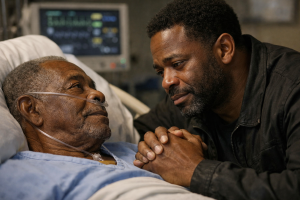
    The person you’re about to evict

    Is the reason you ever had a door to knock on.
  • “My Son Stopped Asking”

    My name is Elena.

    I’m 34 years old. Single mom. One son.

    And three weeks ago, my son stopped asking for things.

    At first, I didn’t notice.

    Then I realized…
    he hadn’t mentioned the school trip in days.

    Every year, his class goes to the science museum.
    He had talked about it for months.

    But suddenly?

    Silence.

    One night, while folding laundry, I asked casually:

    “Aren’t you excited about the trip anymore?”

    He shrugged without looking at me.

    “It’s okay.”

    That was new.

    My son is never “okay.”


    The permission slip was still in his backpack.

    At the bottom, in red ink:

    $45 due Friday.

    Friday was tomorrow.

    My bank account had $12.03.

    I sat on the edge of my bed and stared at that number like it might change if I looked long enough.

    It didn’t.


    Later that night, I walked past his bedroom.

    The door was slightly open.

    He was at his desk, counting coins.

    Pennies. Nickels. Dimes.

    He had a little pile going.

    Then he stopped.

    And pushed them all back into a small dinosaur piggy bank.

    I heard him whisper to himself:

    “It’s fine. I don’t even like museums.”

    My chest physically hurt.


    The next morning, he didn’t give me the permission slip.

    He didn’t remind me.

    He didn’t ask.

    He just kissed my cheek and said:

    “Have a good day, Mom.”

    And that’s when I realized…

    He wasn’t being brave.

    He was protecting me.


    👉 Continue reading… because what I found under his pillow that night made me realize how long he had been pretending.

    That night, I went into his room after he fell asleep.

    I told myself I was just tucking him in.

    But really… I was looking for that permission slip.

    It wasn’t in his backpack anymore.

    It wasn’t on his desk.

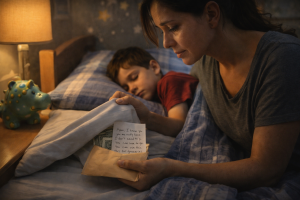
    Then I noticed something slightly sticking out from under his pillow.

    An envelope.

    My hands shook as I opened it.

    Inside were crumpled bills.

    $1.
    $5.
    Even a $10.

    Twenty-seven dollars total.

    And a note written in pencil.

    “Mom, I know you work really hard. I don’t need to go. You can use this for groceries. I’ll watch videos about it instead.”

    I sat on his floor and cried silently so I wouldn’t wake him.

    Because this wasn’t about a museum anymore.

    This was about a child who learned too early that money is heavy.


    The next morning, I went to the school.

    I asked to speak to the teacher privately.

    I explained. I apologized.

    I hated how small my voice sounded.

    The teacher looked at me for a long moment.

    Then she said softly:

    “Mrs. Alvarez… your son already paid.”

    My heart stopped.

    “What?”

    She smiled gently.

    “He gave me an envelope yesterday. He said it was all he had. I told him the rest was taken care of.”

    I felt the room tilt.

    “The rest?”

    She nodded.

    “The PTA has a quiet fund for moments like this. But he didn’t know that.”


    When I picked him up that afternoon, he ran to me.

    “Mom! Guess what? I’m going!”

    I knelt down and held his face in my hands.

    “You were always going,” I whispered.

    That night, I put the $27 back under his pillow.

    But I added something else.

    A small folded note.

    “You never have to protect me. That’s my job.”


    Some people think poverty is just numbers.

    It’s not.

    It’s the moment your child learns to shrink his dreams so yours don’t feel smaller.

    And I promised myself that night…

    He will never stop asking again.

  • “He Refused to Buy the Shoes”

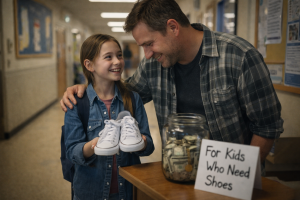
    My name is Daniel Carter. I’m 41 years old.

    And last Saturday, my daughter looked at me like I had broken her heart.

    We were standing in a small shoe store.
    She was holding a pair of white sneakers against her chest.

    “They’re on sale, Dad.”

    They were $38.

    I checked my bank app while pretending to look at the price tag again.

    $14.72.

    I forced a smile.

    “Maybe next month.”

    She nodded too fast. Too brave.

    “It’s okay. Mine still fit.”

    They didn’t.

    I had seen the red marks on her heels that morning.


    That night, after she went to bed, I opened the kitchen drawer filled with unpaid bills.

    Electricity overdue.
    Car payment tomorrow.
    Insurance final notice.

    I stared at my old guitar leaning against the wall.

    It was the last thing I kept after her mom left.

    I listed it for sale.

    Within an hour, someone offered $60.

    I hesitated.

    Then I typed:
    “Deal.”


    The next afternoon I picked up the sneakers.

    I imagined her face when she’d open the box.

    But when I got home, something stopped me cold.

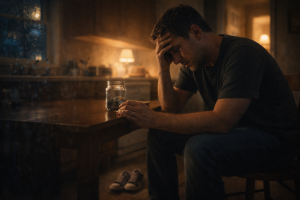
    A small glass jar on the kitchen table.

    Inside were crumpled bills and coins.

    And a folded note.

    “Dad, I’ve been saving from my lunch money. You can use this for bills. I don’t need the shoes.”

    Inside the jar…

    $39.16.

    More than the shoes cost.

    My hands started shaking.

    And then my phone buzzed.

    A message from the guitar buyer.

    “I Googled you. You used to play at charity events. Keep the guitar. I just sent extra.”

    I checked my account.

    $100.

    No name. No explanation.

    Just:

    “For her.”

    And that’s when I realized…

    this wasn’t just about shoes anymore.


    👉 Continue reading… because three days later, my daughter did something at school that would change not just our lives — but the lives of dozens of other families.

    Three days later, my phone rang at work.

    “Mr. Carter? This is the school principal. Could you come in today?”

    When you’re barely staying afloat, every unexpected call feels like disaster.

    My heart was already racing before I hung up.

    All I could think was:
    Please don’t let it be something I can’t fix.


    When I walked into the office, my daughter was sitting there.

    Wearing the new white sneakers.

    She ran toward me and hugged me tightly.

    I noticed something strange.

    She wasn’t in trouble.

    She looked… proud.

    The principal smiled.

    “Your daughter started something.”

    I frowned.
    “Started what?”

    He turned his computer screen toward me.

    There was a photo of a mason jar sitting on her classroom desk.

    With a handwritten label:

    ‘For Kids Who Need Shoes.’

    My chest tightened.

    “She stood up in class,” the principal continued,
    “and told everyone that sometimes parents work very hard but still can’t buy things right away. And that it’s not something to be ashamed of.”

    My throat went dry.

    “She said, ‘My dad tries his best. And that’s enough.’”

    I felt something break inside me.


    In three days, that jar collected $312.

    Parents saw it on social media.
    Teachers shared the story.
    Local businesses offered to help.

    By the end of the week, the school created a permanent fund.

    They named it after her.

    The Carter Closet.

    Shoes. Jackets. Backpacks.

    For any child who needed them.

    No questions asked.


    That night, I sat at the kitchen table again.

    The same table where I almost sold my guitar.

    She walked in, still wearing those white sneakers.

    “Dad?”

    “Yeah?”

    She smiled.

    “See? We’re not poor. We just help when we can.”

    And in that moment, I understood something.

    I thought I was raising her.

    But she was raising me.


    I didn’t lose my guitar that week.

    But I lost something else.

    The shame.

    And I’ve never felt richer in my life.

  • My Son Asked Me If We Were Poor (((

    It was 9:47 p.m. when my 11-year-old son knocked on my bedroom door.

    He never does that.

    He stood there in his pajamas, holding something behind his back.

    “Dad… are we poor?”

    I laughed at first.

    “Why would you ask that?”

    He didn’t laugh.

    He just stared at the floor.

    At school that day, a classmate told him only “poor kids” wear the same shoes two years in a row.

    He looked down at his sneakers.

    The same ones I promised to replace last month.

    I felt something twist in my chest.

    “We’re fine,” I said quickly. Too quickly.

    He nodded.

    But he didn’t move.

    Instead, he slowly pulled his hand from behind his back.

    It was a small glass jar.

    Filled with coins.

    Pennies. Nickels. Dimes.

    “I’ve been saving this,” he whispered. “In case we need it.”

    My throat tightened.

    “For what?” I asked.

    He shrugged.

    “For rent. Or groceries. Or… electricity.”

    I didn’t know whether to cry or break.

    I told him he didn’t need to worry about those things.

    He nodded again.

    But before leaving, he said something I will never forget.

    👇 Continue reading — because what he said next made me realize my son had been carrying a weight no child should carry.

    Before he walked out, he turned back and said:

    “I heard you and Mom talking last week.”

    My heart stopped.

    We thought he was asleep.

    We were whispering about bills.
    About the overdue notice.
    About how we were going to make it work.

    “I know you said we’d figure it out,” he continued quietly. “But I don’t want you to be scared.”

    Scared.

    He thought I was scared.

    He walked over and placed the jar on my nightstand.

    “I can stop asking for things,” he added. “I don’t really need new shoes.”

    That’s when I broke.

    Because I realized something devastating.

    While I was trying to protect him from financial stress…

    He was trying to protect me.

    An eleven-year-old boy.

    Counting coins in his room at night.

    Planning how to save his parents.

    I pulled him into the tightest hug of my life.

    “We’re not poor,” I whispered.

    “But even if we were… we’d still be rich.”

    He looked confused.

    “Why?”

    “Because we have you.”

    The next day, I picked up extra shifts.

    Not just for the bills.

    But because no child should ever feel responsible for holding up the roof over his own head.

    And I bought him new shoes.

    Not because he needed them.

    But because I needed him to know…

    He’s allowed to just be a kid.

  • My Son Sold His Bike Without Telling Me

    When I found out my 12-year-old son sold his bicycle behind my back, I saw red.

    That bike wasn’t cheap.

    I worked overtime for nearly two months to afford it.
    Skipped lunches. Took extra shifts. Came home exhausted.

    And now it was gone.

    I walked into the garage and the empty space hit me immediately.

    No bike.
    No helmet.
    Nothing.

    I called him downstairs.

    “Where is your bike?”

    He froze for half a second.

    Then quietly said,
    “I sold it.”

    My chest tightened.

    “You WHAT?!”

    He didn’t defend himself.
    Didn’t argue.
    Didn’t cry.

    Just stood there, looking smaller than I had ever seen him.

    “I needed the money.”

    Needed?

    For what?

    I demanded answers.

    But he just kept repeating,
    “I’m sorry, Dad.”

    That made me angrier than if he had shouted back.

    I grounded him immediately.
    No phone. No games. No friends.

    That night, I couldn’t sleep.

    Not because of the money.

    But because something didn’t sit right.

    He didn’t look selfish.

    He looked… afraid.

    The next morning, while putting his laundry away, I noticed something tucked inside his backpack.

    An envelope.

    👇 Continue reading — because what I found inside that envelope made me realize my son wasn’t being selfish… he was protecting someone.

    Inside were crumpled bills.

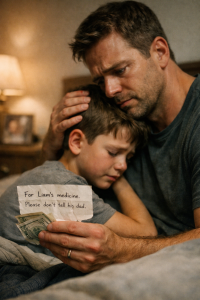
    $312.

    And a note.

    Written in his messy handwriting:

    “For Liam’s medicine. Please don’t tell his dad.”

    My hands started shaking.

    Liam is the little boy who lives three houses down.

    Single father. Recently lost his job.

    His son has severe asthma.

    I sat on my bed because my knees felt weak.

    Suddenly everything made sense.

    The hesitation.
    The silence.
    The guilt that didn’t look like guilt.

    I called my son into the room.

    He walked in slowly, expecting another lecture.

    Before I could speak, he whispered:

    “I know you worked hard for that bike. But Liam couldn’t breathe yesterday. His dad was crying. They said the insurance didn’t cover everything.”

    I couldn’t say a word.

    “I didn’t want him to feel embarrassed,” he added. “So I didn’t tell anyone.”

    That’s when it hit me.

    He didn’t sell the bike because he was careless.

    He sold it because someone else needed to breathe.

    I pulled him into the tightest hug I’ve ever given.

    “I’m proud of you,” I whispered.

    And for the first time in my life…

    I understood what real character looks like.

    That weekend, we went back to the store.

    I bought him another bike.

    But this time, I wasn’t just buying a gift.

    I was honoring the kind of man he was already becoming.

  • The Couch

    For as long as I can remember, my father slept in the living room.

    Every night around 10:30, he would fluff the same faded pillow, pull the same thin blanket over his legs, and turn the TV volume down to almost nothing.

    My mother slept in their bedroom.

    I never questioned it.

    When I was younger, I assumed they argued.
    When I was a teenager, I assumed they had grown apart.
    When I became an adult, I assumed it was normal.

    I once asked him, jokingly,
    “Dad, did Mom kick you out?”

    He smiled.

    “Nah. I snore too much.”

    That was it. That was the explanation.

    And I believed him.

    Seventeen years passed like that.

    Seventeen years of him waking up before everyone else.
    Making coffee.
    Packing my lunch when I was in school.
    Leaving for work quietly so he wouldn’t wake my mom.

    Then one winter morning, he didn’t wake up.

    He passed away peacefully on that same couch.

    The pillow still under his head.
    The blanket still tucked under his chin.

    At the funeral, everyone talked about what a devoted husband he was.

    I nodded politely.

    I didn’t understand what they meant.

    Until a week later.

    When my mother asked me to help her move something in the bedroom.

    👇 Continue reading — because what I discovered behind their bedroom door made my knees give out.

    It was the first time I had been inside their bedroom in years.

    It felt… untouched.

    My mother opened her closet and pulled out something I had never seen before.

    A small oxygen machine.

    Tubes. Masks. Medication.

    “I didn’t want you kids to worry,” she said softly.

    She sat on the edge of the bed.

    “I developed severe sleep apnea years ago. It was bad. Really bad. I would stop breathing in my sleep.”

    I felt my stomach drop.

    “He stayed awake the first few nights to make sure I was okay,” she continued. “Every time I stopped breathing, he would shake me gently.”

    She paused.

    “Then he decided it would be easier if he just slept in the living room. So I could rest without feeling watched… or guilty.”

    Seventeen years.

    He didn’t sleep on the couch because they were distant.

    He slept there because he was afraid she might stop breathing.

    And he wanted to hear it if she did.

    My mother looked at me with tears in her eyes.

    “He told me once… ‘If something happens, I want to be the first one to know. Not the morning.’”

    That couch wasn’t a habit.

    It was a promise.

    And suddenly, every memory shifted.

    The quiet mornings.
    The coffee already made.
    The way he always looked tired but never complained.

    Love doesn’t always look like flowers.

    Sometimes it looks like a worn-out couch.

    And a man who chose it.

    For seventeen years.

  • I Sent Her to Voicemail

    The last time my mother called me, I watched it ring.

    I didn’t answer.

    I remember exactly where I was — sitting in my car outside the grocery store, engine running, staring at her name lighting up my screen.

    “Mom ❤️”

    It rang once.
    Twice.
    Three times.

    I felt slightly irritated.

    She had already called earlier that week.
    Probably to remind me to eat properly.
    Or to tell me something small that felt big to her.

    I hit “Decline.”

    Then I typed:
    “Can’t talk right now. I’ll call you tonight.”

    She replied with a heart.

    Just a heart.

    That night, I forgot.

    Work ran late. Emails piled up. I was exhausted.

    I told myself, I’ll call tomorrow.

    Tomorrow came with three missed calls from the hospital.

    My mother had collapsed in her kitchen.

    They found her on the floor next to the stove.
    A pot still burning.

    The doctor said it was sudden. Massive. Quick.

    When I arrived, machines were breathing for her.

    Her hands were still warm when I held them.

    I said everything I should have said when she called.

    “I’m sorry.”
    “I love you.”
    “I’ll answer next time.”

    There wasn’t going to be a next time.

    She passed away early the next morning.

    And on my phone…

    There was still one unheard voicemail.

    I couldn’t bring myself to press play.

    Because once I did…

    That would be the last new thing I would ever hear from her.

    👇 Continue reading — because what she said in that 32-second voicemail is something I will carry for the rest of my life.

    It took me eight months to listen to it.

    Eight months of staring at “1 Unheard Message.”

    Eight months of pretending she might still call again.

    One night, alone in my kitchen, I finally pressed play.

    Her voice filled the room instantly.

    Soft. Slightly out of breath.

    “Hi sweetheart… I know you’re busy.”

    I started crying before she even finished the sentence.

    “I just wanted to hear your voice today. I had this strange feeling… and I thought maybe if I called, it would go away.”

    My chest tightened.

    “I made your favorite soup. Habit, I guess.”

    A small laugh.

    Then a pause.

    The kind where someone is deciding whether to say something heavier.

    “I’m proud of you. Even if we don’t talk every day… I carry you with me. Everywhere.”

    I covered my mouth.

    At the very end, her voice cracked slightly.

    “Call me when you can. I love you more than you’ll ever understand.”

    The message ended.

    32 seconds.

    That was all I had left.

    No dramatic goodbye.
    No warning.

    Just love.

    And now, whenever my phone lights up and it says “Mom” — because I still haven’t changed the contact name —

    For half a second…

    I still believe it’s her.

    And I would give anything — anything — to go back and answer that call.

  • My Son Started Locking His Bedroom Door — Then I Found Out Why

    “If you tell your parents, I know where you live.”

    The first time I noticed it, it was 11:38 p.m.

    A click.

    The sound of a lock turning.

    My son had never locked his door before.

    He’s 15.

    Quiet. Polite. A little withdrawn lately, but I blamed it on teenage mood swings.

    The second night, it happened again.

    Click.

    And then whispering.

    At first, I thought he was gaming with friends.

    But when I stood outside his door…

    There was no laughter.

    No music.

    Just silence.

    Then a low voice.

    Not his.

    My chest tightened.

    I knocked lightly.

    “Ethan?”

    The whispering stopped immediately.

    A few seconds passed.

    Then his voice, too calm:

    “Yeah?”

    “Who are you talking to?”

    “No one.”

    I stood there longer than I should have.

    Something felt wrong.

    The next morning, he barely looked at me during breakfast.

    Dark circles under his eyes.

    Phone face down on the table.

    “Everything okay?” I asked.

    “Fine,” he said quickly.

    Too quickly.

    That afternoon, the school called.

    “Has Ethan seemed… different at home?”

    My heart dropped.

    “What do you mean?”

    “He’s been tired. Distracted. And he asked the counselor something concerning.”

    Ice spread through my body.

    “What did he ask?”

    There was a pause.

    “He asked what happens if someone online says they’ll hurt your family.”

    My hand started shaking.

    Online?

    That night, when I heard the click again…

    I didn’t knock.

    I used the spare key.

    I opened the door quietly.

    Ethan was sitting on his bed.

    Crying.

    Phone in his hand.

    And on the screen…

    A message:

    “If you tell your parents, I know where you live.”

    My vision went red.

    👇 Continue reading — what I discovered next made me realize my son wasn’t hiding something… he was trying to protect us:

    He jumped when I stepped inside.

    “Dad, don’t!”

    His panic wasn’t guilt.

    It was fear.

    “Who is this?” I demanded, grabbing the phone.

    He tried to pull it back.

    “They said not to tell you!”

    “Who said?!”

    Tears streamed down his face.

    “I messed up,” he whispered.

    My anger softened immediately.

    “What happened?”

    He couldn’t look at me.

    “A guy online. He said he was 17. He wanted to play games together. Then he asked for a picture.”

    My heart stopped.

    “What kind of picture?”

    Silence.

    Then barely audible:

    “One without my shirt.”

    The room felt like it tilted.

    “He said if I didn’t send more, he’d send the first one to everyone. To you. To Mom. To my school.”

    My son had been carrying this alone.

    Locking his door.

    Whispering at night.

    Trying to negotiate with someone who was blackmailing him.

    “Why didn’t you tell me?” I asked softly.

    His voice broke.

    “Because he said he’d hurt you. And I thought… if I just did what he wanted, maybe he’d leave you alone.”

    That sentence destroyed me.

    He wasn’t hiding something shameful.

    He was protecting us.

    A 15-year-old boy trying to carry a threat bigger than him.

    I sat down next to him.

    “You are not in trouble,” I said firmly.

    He looked shocked.

    “You’re not mad?”

    “I’m furious,” I said.

    “Just not at you.”

    That night, we reported everything.

    Police. School. Cybercrime unit.

    It wasn’t quick.

    It wasn’t easy.

    But it ended.

    Weeks later, Ethan stopped locking his door.

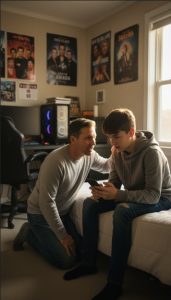
    One evening, he came downstairs and sat next to me on the couch.

    “Dad?”

    “Yeah?”

    “Thanks for not yelling.”

    I put my arm around him.

    “You never have to protect us alone,” I said.

    He leaned into me like he used to when he was little.

    Sometimes strength isn’t about fighting monsters.

    Sometimes it’s about opening the door before your child breaks under the weight of one.


  • The Police Knocked on My Door at 2:17 A.M. — But They Weren’t Looking for Me

    The knock wasn’t normal.

    It wasn’t polite.

    It was urgent.

    Hard. Repeated. Demanding.

    I looked at the clock.

    2:17 a.m.

    Nobody brings good news at 2:17 a.m.

    My heart was already racing when I opened the door.

    Two police officers.

    Serious faces.

    “Are you Michael Turner?” one of them asked.

    My throat went dry.

    “Yes.”

    The older officer glanced at his partner.

    “We need you to come with us.”

    Every worst-case scenario exploded in my head.

    “Is this about my wife?” I asked. “My son?”

    They exchanged a look.

    “No,” the younger one said carefully. “It’s about your father.”

    My stomach dropped.

    “My father died three years ago.”

    Silence.

    The older officer studied me.

    “Sir… a man was admitted to County Hospital tonight after a car accident.”

    I didn’t understand.

    “He had no ID. But before he lost consciousness, he kept repeating your name.”

    My pulse pounded in my ears.

    “That’s impossible.”

    The officer’s voice softened.

    “He said, ‘Tell my son I’m sorry.’”

    The air left my lungs.

    My father had died.

    I buried him.

    I stood at his grave.

    I carried his coffin.

    “You have the wrong person,” I whispered.

    The younger officer shook his head.

    “He knew your full name. Your address. Your son’s name.”

    Ice ran through my veins.

    “That’s not possible,” I repeated.

    But I was already grabbing my jacket.


    The hospital smelled like antiseptic and fear.

    They led me down a quiet hallway.

    Room 312.

    I wasn’t ready for what I saw.

    An older man.

    Bruised. Bandaged.

    Gray in his beard.

    But the shape of his face.

    The scar above his eyebrow.

    The way his hands rested.

    It was him.

    It was my father.

    Alive.


    My legs almost gave out.

    The nurse looked at me gently.

    “He’s stable. But he’s asking for you.”

    My father slowly opened his eyes.

    And when he saw me…

    He started crying.

    👇 Continue reading — what he told me next destroyed everything I thought I knew about my childhood:

    I stood at the foot of his hospital bed.

    Three years.

    Three years of grief.

    Of anger.

    Of unanswered questions.

    “You’re dead,” I said quietly.

    He let out a broken laugh.

    “I know.”

    The sound of his voice hit me harder than seeing his face.

    “Whose funeral did I attend?” I demanded.

    His eyes filled with tears.

    “My brother’s.”

    My mind couldn’t process it.

    “He didn’t have anyone left,” my father continued weakly. “No kids. No wife. He… he looked enough like me.”

    I stared at him.

    “You let us think you were dead?”

    He closed his eyes.

    “I thought you’d be better off.”

    Rage surged through me.

    “You don’t disappear to make someone’s life better!”

    He winced — not from pain.

    From shame.

    “I was in debt,” he whispered. “Bad debt. I got involved with the wrong people. I thought if I vanished… they’d stop looking at you.”

    My chest tightened.

    “You left Mom alone.”

    “I know.”

    “You left me thinking I wasn’t worth staying for.”

    That one broke him.

    Tears slipped down the sides of his face.

    “That was never it,” he said hoarsely. “You were the only reason I almost didn’t.”

    Silence filled the room.

    “I watched from a distance,” he admitted.

    “What?”

    “Your graduation. Your wedding. I stayed far enough that you wouldn’t see me.”

    My head spun.

    “I saw you become the man I hoped you’d be.”

    The anger inside me started to crack.

    Not disappear.

    But crack.

    “Why now?” I asked.

    “Because when that car hit me tonight… I thought I was really going to die.”

    He swallowed hard.

    “And I couldn’t leave this world twice without telling you I’m sorry.”

    The machines beeped steadily around us.

    For years, I had mourned a man who chose to leave.

    Now I stood in front of a man who thought leaving was protection.

    It didn’t erase the damage.

    It didn’t erase the pain.

    But it changed the story.

    And sometimes…

    That’s enough to start healing.

    I stepped closer to the bed.

    “I don’t forgive you,” I said honestly.

    He nodded.

    “But I’m here.”

    His fingers trembled as he reached for mine.

    For the first time in years…

    I let him hold my hand.

  • The Man Who Sat at My Wife’s Grave Every Sunday Wasn’t a Strang

    Every Sunday at 9:15 a.m., he was already there.

    Same bench.
    Same flowers.
    Same quiet posture.

    The first time I saw him, I thought he was just another visitor.

    My wife, Emily, had passed away eight months earlier.
    Cancer. Fast. Brutal. Unfair.

    I started visiting every Sunday because I couldn’t handle the silence at home.

    That’s when I noticed him.

    Mid-40s. Worn jacket. Always sitting near her grave, staring at the headstone like he was memorizing it.

    At first, I ignored it.

    But by the fourth week, something felt wrong.

    He wasn’t visiting someone else.

    He was visiting her.

    One Sunday, I walked up to him.

    “Can I help you?” I asked, trying to stay calm.

    He stood up immediately.

    “I’m sorry,” he said quickly. “I don’t mean any disrespect.”

    “Then why are you here?” I asked.

    He looked at the grave.

    “Because she saved my life.”

    My heart skipped.

    “I think you have the wrong person.”

    He shook his head. “No, sir. Emily Carter. Oncology nurse. St. Mary’s Hospital.”

    My stomach tightened.

    That was her.

    “She stayed after her shift,” he continued. “Sat with me when I was ready to give up. Told me my daughter needed her father.”

    I felt my throat close.

    “She never told me,” I whispered.

    He swallowed hard.

    “She probably didn’t think it was important.”

    I almost laughed at that.

    She never talked about work much. Said she just did her job.

    The man reached into his coat pocket.

    “I’ve been trying to find you,” he said quietly. “But I didn’t know how.”

    He pulled out an envelope.

    “She asked me to give you this… if something ever happened to her.”

    My world tilted.

    “What do you mean?”

    He hesitated.

    “She knew.”

    My pulse roared in my ears.

    “She knew the treatment wasn’t working. She made me promise.”

    My hands started shaking as I took the envelope.

    I had held her hand every day.
    Slept beside her.
    Told her we would fight this together.

    And she knew?

    👇 Continue reading — what my wife wrote in that letter changed everything I thought I understood about her… and about love:

    I couldn’t open it right away.

    My hands were shaking too hard.

    The man stepped back, giving me space. “She made me promise,” he said quietly. “Only if she didn’t make it.”

    The paper felt thin. Fragile.

    Just like she had been at the end.

    I finally unfolded it.

    Her handwriting.

    I would recognize it anywhere.


    “If you’re reading this, it means I lost the fight. And I’m sorry for the secret I kept from you.”

    My vision blurred.


    “The doctors told me months ago the treatment wasn’t working. I saw it in their faces before they said the words.”

    I felt like the air had been punched out of my lungs.

    Months.

    She had known for months.


    “You would have stopped living the moment you knew. And I needed you to keep living while I still could.”

    A tear dropped onto the page.


    “I didn’t want our last memories to be fear. I wanted laughter. Coffee in bed. Movie nights. Your terrible cooking.”

    I almost smiled through the tears.


    “And there’s something else you deserve to know.”

    My heart stopped.


    “The man giving you this letter… his name is Daniel. When I met him, he had already decided to end his life. He told me he didn’t matter to anyone.”

    My hands trembled.


    “So I stayed after my shift. Not because I’m a hero. But because someone once did that for me when I needed it.”

    I looked up at Daniel. He was crying silently.


    “If you’re reading this, it means Daniel kept his promise. It means he stayed. It means he chose to live.”

    My chest cracked open.


    “Please don’t be angry with me for not telling you. I needed to know that when I was gone, there would still be one more person in this world living fully because I was here.”


    The last line nearly destroyed me.


    “Grieve me. Miss me. But don’t stop living. Love loudly. Help someone when it’s inconvenient. Sit with them when it’s uncomfortable. That’s how you keep me alive.”


    I couldn’t stand anymore. I sat down on the grass beside her grave.

    For months, I had been drowning in the idea that I lost her.

    But in that moment, I realized something different.

    She didn’t just leave this world.

    She expanded in it.

    Through Daniel.

    Through me.

    Through every quiet act of kindness she never talked about.

    Daniel stepped closer. “She told me one more thing,” he said.

    “What?” I asked.

    “She said you’d be proud of her. Even if you were angry first.”

    I laughed softly through tears.

    “She was right.”

    For the first time since she died… I didn’t feel only loss.

    I felt purpose.

    I stood up.

    “Coffee?” I asked Daniel.

    He looked surprised.

    “For her,” I said.

    He nodded.

    As we walked away from the grave, I realized something powerful:

    Love doesn’t end when a heartbeat does.

    Sometimes…

    It multiplies.