In the small city of Grover Falls, Raymond Holt was the kind of man people pointed to when they talked about what a good neighbour looked like.
Retired schoolteacher. Youth baseball coach for nineteen years. Deacon at First Community Church. The man who shovelled your driveway without being asked and remembered every child’s birthday on the street.
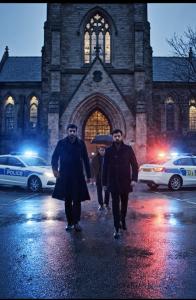
For 27 years, he lived among them.
For 27 years, he smiled at vigils for the very victims he had left behind.
Nobody knew. Nobody even came close.
Until a flooded basement in a house three miles away revealed something that had been sealed inside a wall since 1996.
A small tin box.
Inside it — a wristwatch. A folded note written in handwriting that didn’t belong to anyone who had ever lived in that house. And a photograph.
The kind of photograph that makes investigators go completely silent.
The kind that closes four cold cases in a single afternoon.
Raymond Holt was at a church fundraiser when the police pulled up outside.
He waved at them before he realised they weren’t waving back.
👇 Full story in the comments. What was inside that tin box is something investigators say they will never forget.
For 27 Years He Was Their Neighbour. Then a Flooded Basement Told the Truth He Never Would.
The flood came in March.
Three days of relentless rain pushed the water table past its limit across the lower neighbourhoods of Grover Falls, seeping into crawl spaces and basements and the forgotten corners of old houses that had stood since before the highway was built.
The house at 412 Dunmore Lane had been a rental for years — owned by an elderly woman in a care facility, managed by a property agency that did the minimum required and nothing more. When the agency sent a contractor to assess the flood damage, the man found the usual — warped drywall, ruined insulation, a sump pump that had given up sometime in the night.
He also found a section of the basement wall that had been patched — poorly, and years ago — with a different grade of concrete than the rest. The flood had softened it. He pressed his hand against it and it shifted.
Behind it was a cavity roughly the size of a shoebox.
Inside the cavity was a tin box, sealed with electrical tape that had gone brittle with age.
The contractor called the property agency. The property agency, uncertain what to do, called the non-emergency police line. A patrol officer came out, took one look, and called his sergeant. His sergeant drove over, opened the box with gloved hands, and went very quiet.
Inside were three items.
A man’s wristwatch — a Seiko with a cracked face and an engraved inscription on the back: To David, with love, Mom & Dad. June 1988.
A folded note, handwritten on plain white paper, containing seven lines that the department would not release to the public for another fourteen months.
And a photograph.
The photograph showed a location. A specific, identifiable location — a drainage culvert at the edge of Pembrook Park, two miles from the centre of Grover Falls — with a carefully placed marker visible at the bottom left corner of the frame.
The officer who first looked at it later said the photograph had the quality of something deliberate. Not taken in a moment of panic. Taken by someone who wanted a record.
Someone who wanted, on some level, to remember.
David Kaplan had been 24 years old when he disappeared in October 1996. He had been reported missing by his roommate after failing to show up for work for three consecutive days. His car was found at a trailhead. His body was never located. The case went cold within eighteen months — underfunded, under-investigated, assigned to a detective who retired the following year and took most of his institutional knowledge with him.
Three other cases from the same region shared similar fingerprints — young men, outdoor locations, no bodies recovered, investigations that stalled and quietly died.
They had never been formally linked.
They were linked now.
The name on the property records for 412 Dunmore Lane — not the elderly current owner, but the previous owner, who had sold it in 2001 — was Raymond Arthur Holt.
Raymond Holt had lived at that address for eleven years. He had moved four streets over in 2001 — to a house on Clemson Way, where he had become, by every account, the heart of the neighbourhood.
He was 71 years old. He had a mild manner and a firm handshake and a shelf in his living room lined with photographs of the baseball teams he had coached over the decades. Parents trusted him with their sons. The church trusted him with their youth programme. The neighbourhood trusted him with their spare keys when they went on vacation.
Investigators executed a search warrant on the Clemson Way property on a Thursday morning while Raymond was at a fundraiser at First Community Church. What they found in a locked storage unit in his garage — carefully catalogued, meticulously preserved — confirmed what the tin box had already told them.
He had kept records. Not out of carelessness. Deliberately. As a private archive of something he clearly believed would never surface.
He was wrong.
When two detectives arrived at the church, Raymond saw them from across the car park. He raised his hand in greeting — the reflexive friendliness of a man who had spent decades performing normalcy so fluently he sometimes forgot it was a performance.
Then he saw their faces.
He lowered his hand.
He did not run. He did not speak. He allowed himself to be handcuffed with the quiet resignation of a man who had always known, somewhere beneath everything, that the day would eventually come.
At his arraignment, he said nothing.
But the families of David Kaplan and the three other victims — families who had spent decades without answers, without closure, without even a grave to visit — finally had something they had almost stopped believing they would ever receive.
The truth. Sealed in a tin box. Hidden behind a wall. Waiting twenty-seven years for a flood nobody could have predicted.
The lead investigator on the case, speaking to reporters on the courthouse steps, was asked what she made of the photograph — the deliberate, careful way it had been composed and stored.
She paused for a long moment before answering.
“Some people need to be remembered,” she said. “Even the ones who did the remembering were eventually going to be found out.”
Share this for every family that never stopped waiting for the truth. Justice is sometimes slow. But it comes.
Leave a Reply